

 As every year, on January 15, the Romanian stamp marks the National Culture Day.
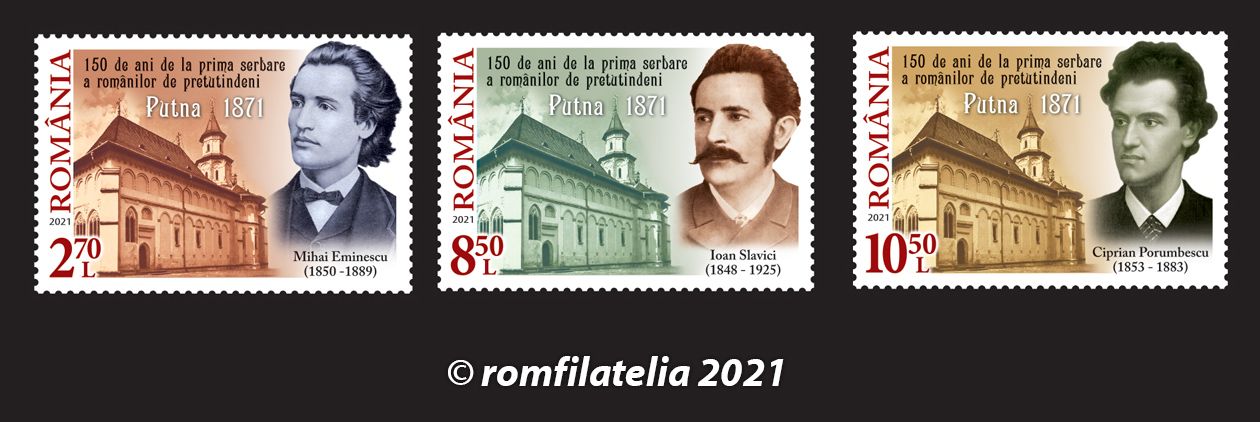
In order to highlight a theme approached for the first time, Romfilatelia introduces into circulation the issue of postage stamps “150 years since the first celebration of Romanians everywhere”, an event that took place at the Putna Monastery, in 1871.
150 years ago, Bucovina was under the rule of Austria-Hungary, being annexed to it in 1775. The Romanian population in Bucovina fought to preserve its ethnic identity and cultivated the ideal of uniting all Romanian territories, thus aligning with the world movement to assert the right of peoples to self-determination and the formation of nation-states, a movement that had a special scope in the nineteenth century.
On the occasion of the 400th anniversary of the consecration of the Putna Monastery, in 1870, the Romanian students gathered in Vienna decided to turn the event into a great national celebration. The outbreak of the Franco-Prussian War, which was joined by repressive measures ordered by the Austro-Hungarian authorities, led to the postponement of the celebration for the following year. Vienna students
they chose the Organizing Committee of the Putna Party, consisting of Ioan Slavici, president, Mihai Eminescu, secretary, and other representatives of Bucovina’s students. Along with them are Nicolae Teclu and A.D. Xenopol.
On the morning of August 15, 1871, over 3,000 Romanians from all over the world attended the Holy Mass at the Putna Monastery. The previous evening, the celebration had been opened with 21 volleys of cannon fired from the tops of nearby hills, followed by a religious service.
After the Holy Mass, A.D. Xenopol gave a lecture about Stephen the Great, as an exponent of the entire Romanian space.
In the afternoon, the violin of the young Ciprian Porumbescu, only 17 years old, moved the whole assembly with her chords. Embracing his father, Ciprian Porumbescu utters the words, which have become famous: “Father, I sang to the whole of Dacia”.
Among the gifts brought by the participants and consecrated during a service was a silver homage urn, which contained earth brought from all Romanian provinces. Placed on the tomb of Stephen the Great, the urn was accompanied by the prayer: “As this earth has united here, God intercedes to unite the places where he was taken!”
On the urn is inscribed a dedication that defines a portrait of the great voivode: “To the hero, the victor, the defender of the Romanian existence, the shield of Christianity, to Ștefanu celu Mare, Junimea Română Academică, MDCCCLXX!”.
It should be mentioned that part of the land contained in the urn deposited on the tomb of Voivode Stefan was sprinkled on the battlefields that made the Great Union possible.
The three postage stamps of the show reproduce, in a suggestive graphic association, next to the church building where Ștefan cel Mare is buried, the portraits of the poet Mihai Eminescu (on the stamp with a face value of 2.70 lei), of the writer Ioan Slavici (on the stamp with face value of 8.50 lei) and the young composer and performer Ciprian Porumbescu (on the stamp with a face value of 10.50 lei).
The block with the three lacy stamps joins the image of the church of Putna Monastery the portraits of the mentioned personalities and the photograph of the homage urn, currently in the Museum of Putna Monastery.
Romfilatelia thanks the Putna Monastery, the National Museum of Bucovina, the National Museum of Romanian Literature, the National Museum of Romanian History and the Library of the Romanian Academy for the documentary and photographic support provided to this postage stamp issue.
The philatelic map is made in a limited edition of 248 copies and is equipped with the special undamaged block of the issue numbered from 001 to 248, as well as with the reproduction on special paper of the facsimile of a letter signed by Ioan Slavici and Mihai Eminescu.