

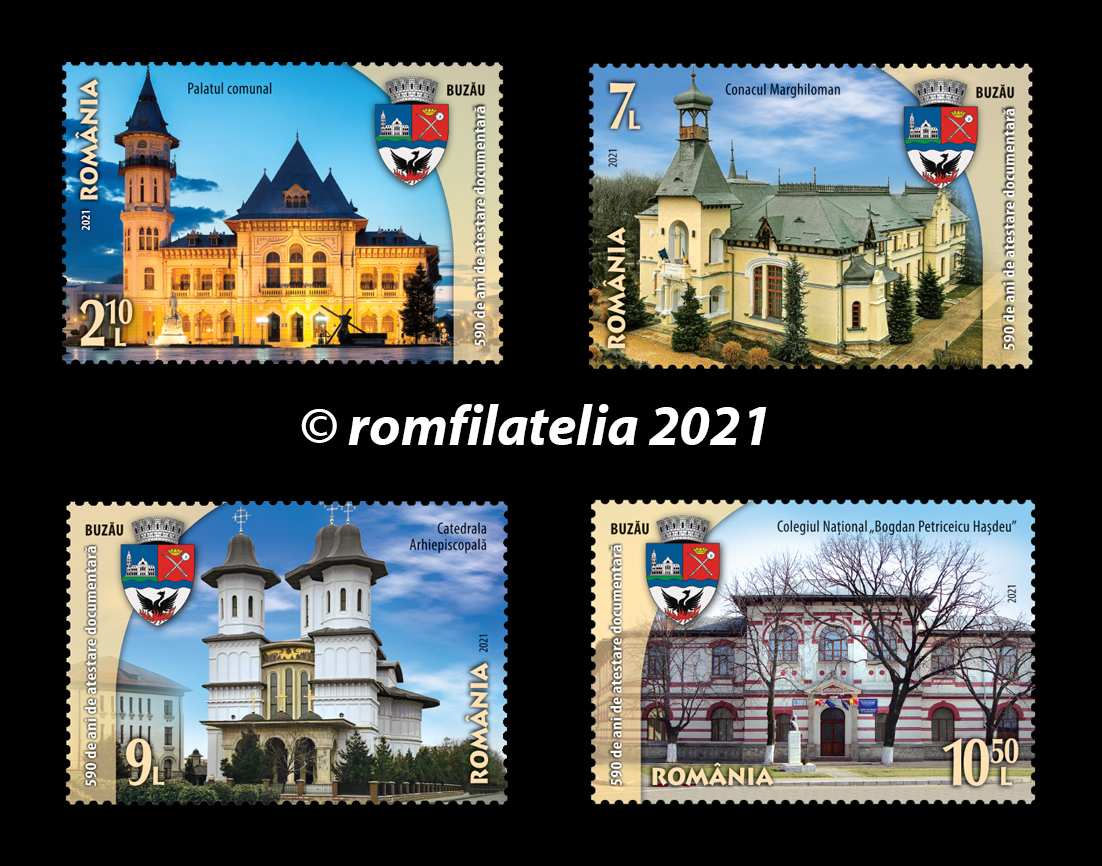
 Romfilatelia introduces into circulation on Tuesday, February 23 a.c., a thematic postage stamp issue from the series Cities of Romania, entitled Buzau, 590 years of documentary attestation.
The city of Buzau is part of the documents of the history of Wallachia as a place where important events took place, among which it is worth mentioning the following: its existence as a fair and customs point (status attested by a document issued at the court of Prince Dan II January 30, 1431), episcopal see, documented in 1525 under the reign of Radu de la Afumați (the diocese was founded in 1500, during the reign of Radu IV, called the Great), the organization, under the rule of Constantin Brâncoveanu , of a printing house under the presses of which valuable books came out in Romanian between 1691 and 1704.
The geographical area in which the city of Buzau is located is historically attested in the text of a document found in copy at the Vatican Library and the San Marco Library in Venice. The text describes the martyrdom of the Christian missionary Sava, drowned in the waters of the Mousaios River (Buzau River). The document was drafted in 374.
The anniversary stamp issue dedicated to Buzău reproduces in its images four representative architectural monuments closely related to the history, culture and social life of the city.
The stamp with a face value of 2.10 lei shows the Communal Palace, located in the center of Buzau, being the current headquarters of the City Hall and the Local Council. It was built between 1899 and 1903 at the request of the mayor of the city, Nicu Constantinescu, according to the project of the architect Alexandru Săvulescu. The inauguration of the building, with the destination of administrative palace, took place in 1903, in the presence of King Carol I and Prince Ferdinand.
Combining neo-Romanian elements with local architectural motifs (found in the boyar houses), to which are added decorative forms that refer to the vine (major presence in the Buzau lands), the architect Săvulescu made one of his reference creations in the field.
After the destruction caused by Allied bombing and fighting between Soviet and German soldiers in August 1944, the Palace was rebuilt in 1947.
Marghiloman Mansion, whose image is reproduced on the stamp with a face value of 7 lei, is a representative architectural ensemble of the city of Buzau. Known as the Marghiloman Palace, built in the second half of the century. 19th century, by Iancu Marghiloman, former mayor of Buzău and a large landowner. After his death, his son, Alexandru Marghiloman, decided to modernize the ensemble, using the services of the famous architect Paul Gottereau.
Starting with 2011, the valuable architectural ensemble has been restored, becoming the Cultural Center “Alexandru Marghiloman”, where various cultural activities are carried out internally and internationally.
The Archbishop’s Cathedral shows the stamp with a face value of 9 lei.
The current building of the Archbishop’s Cathedral was built at the initiative of Archbishop Epiphany, between 2002 and 2009, according to the typical Romanian Christian churches, being divided into narthex, nave and altar.
The painting made in the fresco technique is the work of the painter Petre Brașoveanu from Buzău. On November 8, 2009, in the presence of His Beatitude Father Daniel, the consecration service of the place of worship, the most important in the Archdiocese of Buzău and Vrancea, was officiated.
The “Bogdan Petriceicu Hașdeu” National College, illustrated on the stamp with a face value of 10.50 lei, is the most important high school in Buzău, established in 1867, having as its headquarters a building built on a plot of Banului Monastery. Until 1875 it was called “Tudor Vladimirescu” Gymnasium. Starting with 1932, it is named after Bogdan Petriceicu Hasdeu.
It should be mentioned that, in 1873, Basil Iorgulescu, the first director of the High School, set up in the institution’s headquarters the first library in the city, known as the “Carol I” Public Library. The same culture enthusiast, Basil Iorgulescu, asks the Ministry of Cults and Public Instruction for approval to set up in Buzau a collection of archaeological, historical and ethnographic pieces, the fruit of personal concerns. After four years, a public collection of exhibits is displayed in one of the halls of the “Bogdan Petriceicu Hasdeu” High School. The event is considered to be the birth of the first museum in Buzau.
Romfilatelia thanks the City Hall of Buzău for the documentary support provided to the realization of this issue of postage stamps.