

 Motto:
Pallady is delicate in fragile shades and splendors,
our master tells us the secrets of colors
seen from the inside, wrapped in borangic.
Tudor Arghezi
Romfilatelia introduces into circulation, on Wednesday, April 14, 2021, a new stamp issue dedicated to the fine arts and to one of the masters of modern Romanian painting: Theodor Pallady, 150 years since his birth.
Theodor Pallady was born in Iasi in 1871. After the first years of schooling, he was present in Bucharest (1886) as a student of the School of Bridges and Roads, and later in Dresden, as a student of the Polytechnic of this city. In parallel with his engineering studies, he took painting lessons with Ervin Oehme. He dedicated himself to painting and, in 1889, left for Paris to study in Edmond Aman-Jean’s studio. Later, starting in 1891, as a student at the School of Fine Arts in Paris, she studied in the studio of Puvis de Chavannes, husband of Princess Cantacuzino, the sister of the painter’s maternal grandfather. He has the opportunity to meet Matisse directly, with whom he will form a long friendship. Between 1892 and 1897 he completed his studies with Gustave Moreau, Aimé Morot and Fernand Cormon.
His artistic debut is recorded in 1900, at the Paris Salon and at the Universal Exhibition. In 1902 he exhibited in London, and two years later, at the Romanian Athenaeum.
The painter is later present in genre exhibitions in Barcelona (1929), The Hague and Amsterdam (1930), Venice (1940 and 1942), Bern and Zurich (1943). To these are added the exhibitions in Romania, whose list ends in 1956 with a large retrospective at the Art Museum (202 paintings and 87 graphic works).
Theodor Pallady is the painter of the intimacy of his environment, with an evocative, poetic conception, full of tenderness and sensitivity. The painting, calm and austere, gives a great color intensity. Starting from a painting that explicitly presented the subjects, he arrives at a painting of refinement, close to Matisse’s art, in which the colors are clear, bright and in rigorously constructed rhythms. It is distinguished by a rational spirit of the measure, while avoiding exaggerations. In his painting and especially in the drawings there is sometimes an ironic nuance.
Theodor Pallady’s thematic repertoire is diverse, often featuring nudes, landscapes, flowers, inner static natures and many self-portraits. Rhythm and harmony define the essential elements of his paintings. He is considered a painter of silence and tranquility. His paintings can be compared to those of Marquet and Bonnard. Through his entire artistic creation, Theodor Pallady wrote an innovative and original page in Romanian painting, offering new perspectives on the line of painting intellectualization.
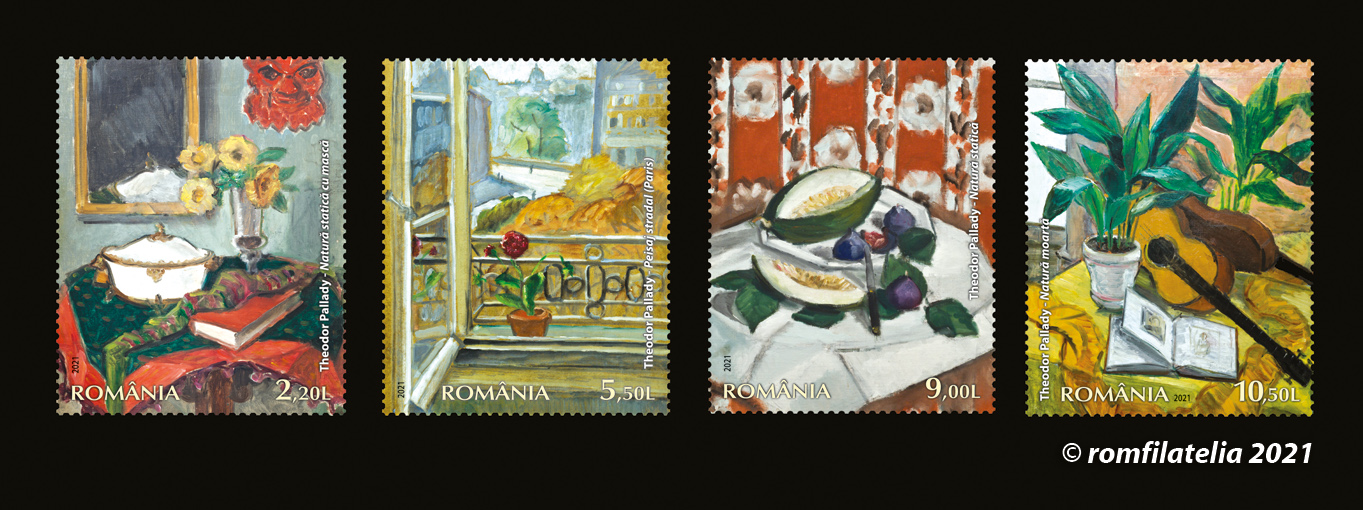
The issue of postage stamps, consisting of 4 stamps and a lacy package, reproduces representative paintings for the artist’s creation: static natures, self-portraits, Parisian landscapes.
On the four stamps are reproduced paintings by Theodor Pallady that are part of the painting collection of the Bucharest Art Gallery, all attesting to the artist’s interest in the genre of static nature, richly represented in his work. The whole creation of Theodor Pallady in this genre is based on classical compositions, thematically restricted, structurally-logical, with balanced proportions, bright chromatic and spontaneous touch. Static natures reproduce the surrounding reality, and go beyond it, whether it is a mask, plant, guitar, bread, a fruit cut into slices, all in the genre props of the artist, who knew how to build an intimate environment.
The first stamp, with a face value of 2.20 lei, reproduces the painting Static Nature with a mask. Formed mainly in the workshops of French painters (especially Gustave Moreau) whose technique and repertoire take on oriental elements, Theodor Pallady nevertheless develops his own conception of the Orient, which he views through the prism of a temperate modernism and which he captures, after 1920, in various themes. Thus, we find in its static natures different objects probably seen in museums in the Far East (statuettes or masks – as we can see in this work) or fruits in the East (lemons, pomegranates), the compositions containing several decorative backgrounds of Matissian inspiration.
On the second stamp, with a face value of 5.50 lei, is illustrated the painting Street Landscape (Paris). The work makes the transition between the static natures and the landscapes of Theodor Pallady, linking them intelligently and sensitively. The surprise of the flower placed on the window sill wide open to the street, the chromatic subtlety with a warm dominance, vibrated by the free touches, betrays a post-impressionist influence. The contrast of quantity made the flowerpot in the Street Landscape be bathed in the sandy tones of the background supported by the neutral grays in the distant plane. The synthesis of forms helped the artist to keep his faith.
l: “Everything that does not go beyond reality is not art”.
On the third stamp, with the nominal value of 9 lei, is represented the work Static Nature. Theodor Pallady’s preferences for interior compositions will lead to the appearance of exceptional series of static natures, which will always resonate with the artist’s spirit. With an ever-changing prop, consisting of objects inside his workshops, such as flower pots, paintings, books, boxes, glasses, pipes, statuettes or sliced fruit (as in this case), arranged in a balance carefully established by the perfectionist artist, Pallady will seek in his compositions the discovery of a new world, perfectly balanced. The work was part of the collection of Dr. A.I. Siligeanu and was purchased in 1978.
The fourth stamp, with a face value of 10.50 lei, shows the work Still Life. Everyday objects capture the expressiveness of materiality, a social context of the past and present that speaks about the artist’s concerns. A mirror reflects the image of the pot and the guitar, giving three-dimensionality to the work. The ocher and raw green of the plant are like two musical notes that compose a symphony of colors. The work comes from the great collector Luca Lasserson.
The lacy stamp of the package, with a face value of 31.50 lei, reproduces the work Static Nature with tulips (oil on cardboard, belonging to the Prahova County Museum of Art “Ion Ionescu-Quintus”), and on the package of the package, the work Self-portrait (oil on cardboard, from the collection of the Brukenthal National Museum).
Self-portraits of Theodor Pallady are reproduced on the cuffs of the little ones; two of them belong to the Library of the Romanian Academy, and another two – to the Prahova County Museum of Art “Ion Ionescu-Quintus”.
On the two envelopes “the first day” of the show are also illustrated two self-portraits of the painter, in the collection of the Library of the Romanian Academy.
Romfilatelia thanks the Library of the Romanian Academy in Bucharest, the Museum of Bucharest, the Prahova County Museum of Art “Ion Ionescu-Quintus” and the Brukenthal National Museum for the documentary and photographic support provided to this postage stamp issue.