

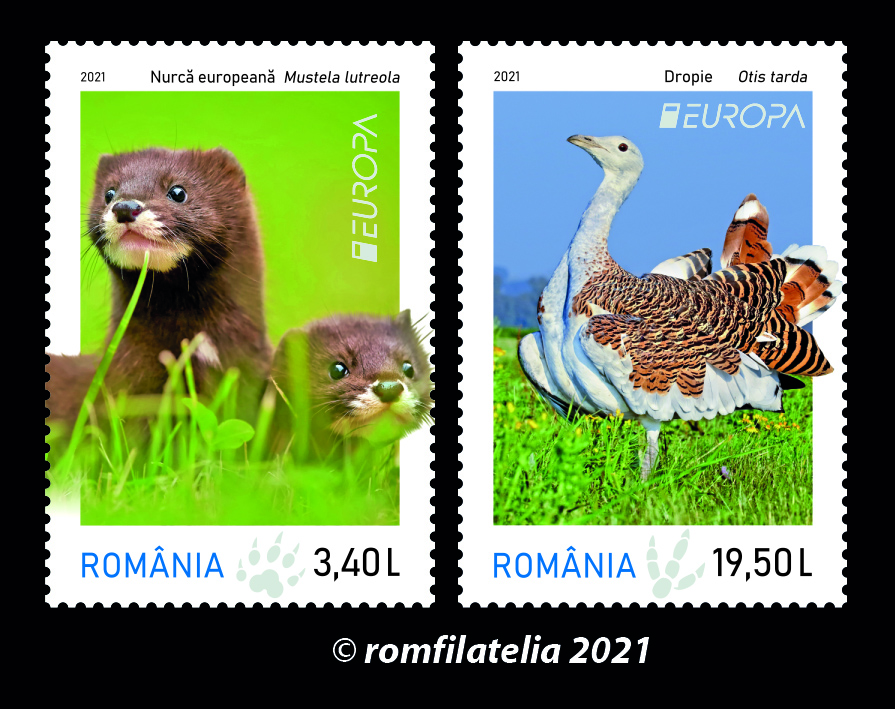
 This year, under the generic Europe 2021, PostEurop, a body of the Universal Postal Union, a specialized agency of the United Nations, has chosen a topical issue, in the context of the need to protect endangered European wildlife: Endangered National Species.
Romfilatelia introduces into circulation, on Thursday, April 22, 2021, an issue of postage stamps with this name, consisting of two stamps. The stamps depict two endangered species of Romanian fauna: the European mink and the bustard.
Elements visible only in ultraviolet light are also printed on stamps and vignettes.
The first stamp of the issue, with a face value of 3.40 lei, shows the European mink (Mustela lutreola).
The mink lives near water, in swampy areas or near rivers, spending a lot of time in the water, looking for food. It is a medium-sized mammal (30-40 cm long), with a slender, elongated body, with limbs provided with an interdigital membrane, which helps it to swim. It is a predatory species; it feeds on fish, amphibians, crustaceans, small mammals.
Once widespread throughout Europe, the mink has today become one of the rarest and most endangered mammals on our continent. In some Western European countries, it has disappeared since the eighteenth century, and today it exists only in a few countries, including Romania. On the IUCN (International Union for Conservation of Nature) Red List, the mink has the status of a critically endangered species – meaning it is only one step away from being declared extinct in the wild.
One of the causes is the destruction of the habitats of this species. Many vertebrate species have suffered from fragmentation and restriction of wetlands, to which has been added water pollution.
In Central and Western Europe, a major problem was the introduction of a foreign species, the American mink (American mink), which competed with the European mink for food resources and spread diseases that also infected European minks. A direct cause of the decline was hunting, the thick and fine fur of the mink being highly valued.
Today, several large-scale projects are aimed at restoring European mink populations. One of the areas where there is still a large population is the Danube Delta Biosphere Reserve (RBDD). Romania is carrying out an extensive conservation project, co-financed by the European Regional Development Fund: “Ensuring a favorable conservation status for rescuing from extinction the European mink population – Mustela lutreola (species of community interest, critically endangered) – in Romania.” The project is implemented by the Danube Delta Biosphere Reserve Administration in partnership with the Danube Delta National Research and Development Institute and includes: restoration of natural areas in RBDD affected by construction, reorganization of tourism in RBDD, combating poaching, but also awareness actions in all schools from the localities in RBDD, regarding the importance of biodiversity conservation.
On the second stamp of the issue, with a face value of 19.50 lei, is represented the bustard (Otis tarda).
Dropia is the largest bird species in Europe in weight: adult males can weigh more than 15 kg. (Females are much smaller, weighing 4-5 kg.) Another characteristic of males are the so-called “mustaches”, in fact modified feathers, which grow at the base of the beak and reach the maximum length (about 20 cm) during the breeding period. .
Dropia is a plain bird; lives in steppe meadows, but also on land cultivated with rapeseed, alfalfa, cereals. It feeds on vegetation, insects and small vertebrates. The area of this species extends from Western Europe (Spain and Portugal) to Central and Eastern Asia.
Dropia was once widespread in the plains of Romania, but the spread of human civilization has profoundly affected this species: the vast desert meadows, where birds lived quietly, have been transformed into arable land, irrigated, sprayed with pesticides, constantly traversed by humans and agricultural machinery. ; high voltage lines have appeared, which can lead to the death of many specimens, because the bustards, despite their size, can fly at high speed. To these were added hunting and poaching, the bustard being considered not only a tasty meat game, but also a trophy. Dropia is a very vigilant bird and does not tolerate the presence of man less than 250 m away, making it difficult to shoot, but people have found ingenious solutions to get closer to the right distance for shooting. The peasants hid, for example, behind some silhouettes of cows, made of cardboard or wood. Another method was to hunt from the cart: the hunter was hiding under the mats, thus being able to approach the bustards, who were not afraid of carts and horses.
Finally, hunting and habitat destruction have led, in our country, to such a drastic decrease in numbers, in as in the 1990s the bustard was considered extinct in Romania.
In recent years, several specimens have been observed in the west of the country and in Bărăgan, which in all probability belonged to the populations of neighboring countries. It was a surprise to discover, in 2020, a nest with dropie eggs on an agricultural land in Salonta, Bihor County. Ornithologists from the Milvus Group Association, one of the most active NGOs in Romania in the field of bird and nature protection, hypothesized that the bustards would have kept at Salonta “one last center of resistance” and that there would be a small cross-border population of 40-50 specimens, occupying a territory located on either side of the border with Hungary.
Therefore, the bustard also lives in Romania, but it remains a vulnerable species and only through strict protection measures can we hope to see this magnificent bird populating the Romanian plains again.
A memorandum was drawn up under the Bonn Convention to conserve the Central-Eastern European bustard population. Romania signed this agreement in November 2000.
A Natura 2000 protected area has been designated near Salonta, which is called Cefa Fishery – Rădvani Forest. Although insufficient in area, it offers at least the advantage that, here, investment projects that would negatively affect the dumps can be prevented. Since 2017, a new package of agri-environmental measures has been applied within the National Rural Development Program, which provides compensatory payments for farmers who manage their lands by applying agricultural methods to protect the vines.
Romfilatelia thanks the National Museum of Natural History “Grigore Antipa” for the documentary support offered to this postage stamp issue.
The philatelic album is made in a limited edition of 361 copies and is equipped with the special philatelic block of four undamaged stamps and a vignette with a round perforation, with the envelope “first day”, with the stamp clearly applied, in folio, a vintage engraving. Elements visible in UV light are printed on stamps and vignettes. The special philatelic block, the “first day” envelope and the engraving reproduced are numbered from 001 to 361.