

 Romfilatelia introduces into circulation, on Thursday, May 6, 2021, a new issue of postage stamps dedicated to the biodiversity of our planet: Mushrooms.
Although considered plants for a long time, fungi (fungi) are, in reality, a completely different group of living things. Fungi cannot perform photosynthesis, like plants, they feed by absorbing organic substances from the substrate in which they grow. In fact, at the cellular level, fungi are, in some ways, more like animals than plants. There are no animals, no plants, no eukaryotic organisms in a special group – the Fungi Kingdom. To date, approximately 148,000 species have been described, from microscopic forms (microorganisms such as yeasts and molds) to macroscopic species, sometimes of impressive size (in Armillaria bulbosa, the mycelium can grow in the soil on an area of 15 ha). .
Fungi grow either on different substrates – organic matter, soil, dead wood – or on living organisms: plants, animals, other fungi.
Fungi play an essential role in nature, breaking down organic matter into simpler substances that can be absorbed by plants. A major impact on the environment has parasitic fungi, as well as those who establish relationships of mutualism (mutual aid) with other organisms.
Generally, the fungus consists of a branched structure, usually hidden in the substrate, called a mycelium. It consists of filaments called hyphae, with which the fungus absorbs nutrients from the substrate on which it grows. In the case of species called macromycetes,
Under certain conditions, specific, macroscopic structures are formed from the mycelium, called fruiting bodies (sporophores). In general, they come to the surface of the substrate and produce spores (specialized cells through which fungi multiply). From the spores reached on a suitable substrate, the mycelium is formed, and from it periodically fruiting bodies are formed. What we commonly call a “mushroom” is, therefore, the fruiting body of macroscopic fungi, visible on the surface of the substrate. This fruiting body can be, depending on the species, of different shapes, colors and sizes.
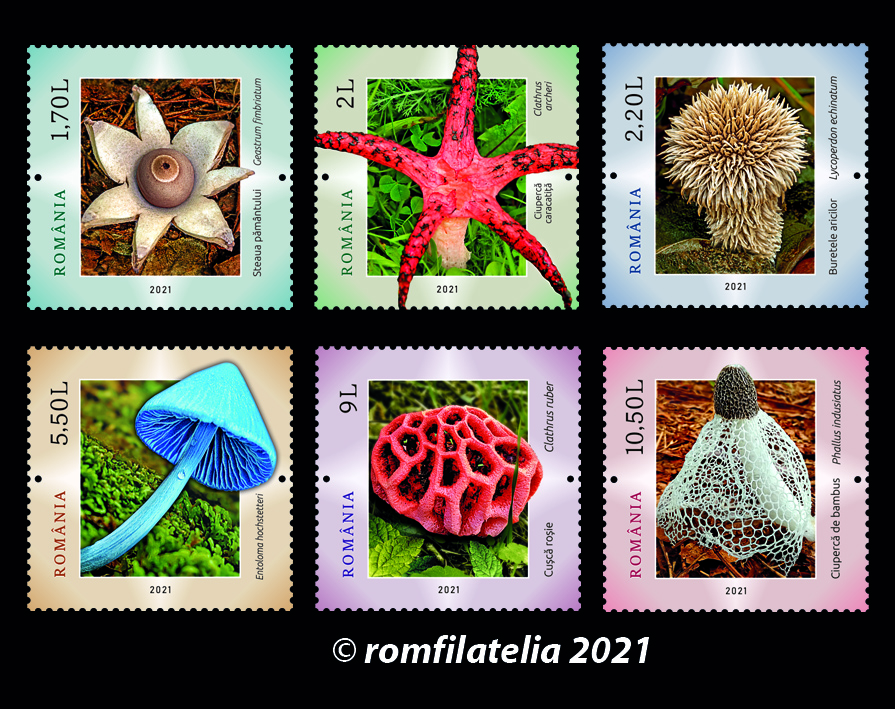
The six stamps of the series present fungi with spectacular fruiting bodies in shape or color, reflecting the extraordinary diversity of this group of living things.
On the first stamp, with a face value of 1.70 lei, is represented the star of the earth (Geastrum fimbriatum). This fungus grows on the humus-rich soil of deciduous and coniferous forests. The immature fruiting body is spherical, totally or partially buried in the ground. When mature, the thick outer shell divides into several sharp-pointed lobes, giving the fungus the shape of a star. In the middle is a globular, membranous structure in which the spores are found. This mushroom is inedible due to its strong, fibrous texture.
On the second stamp, with a face value of 2 lei, is illustrated the octopus mushroom (Clathrus archeri), a species native to Australia, where it arrived in other regions of the world, being discovered in Romania. The fruiting body is initially spherical, white. At maturity it has the appearance of an “octopus” with 4-8 arms arranged radially, pink or red. It has a repulsive odor, attracting insects that contribute to the spread of spores.
On the third stamp, with a face value of 2.20 lei, is represented the sponge of hedgehogs (Lycoperdon echinatum). It has a globular shape, which thins towards the base. The fruiting body is cream-colored, and the surface is covered with a layer of long thorns, which fall to maturity. In the young stage, the inner tissue is white and firm; at maturity, it turns into a brown, dusty mass containing spores. It also grows in our country, in deciduous forests, on calcareous soil.
The fourth stamp, with a face value of 5.50 lei, shows the species Entoloma hochstetteri. It is a species native to New Zealand, more recently being found in India. It grows on the soil of coniferous and deciduous forests. The fruiting body is 5-10 cm high and 4 cm in diameter. It is one of the few species of blue fungus. It appears on one of the New Zealand banknotes, being a characteristic species for the biodiversity of this country.
On the fifth stamp, with a face value of 9 lei, is represented the red cage (Clathrus ruber). It is a species native to Europe, from where it has spread to other continents, and is rarely found in our country. The fruiting body is initially spherical; then, its shell cracks, and the fruiting body develops in the form of a globular network, red in color, which can reach 20 cm in height. Due to the repulsive smell, it is avoided by people.
On the sixth stamp, with a face value of 10.50 lei, is illustrated the mushroom.
It is bamboo (Phallus indusiatus), widespread in the tropical regions of South Asia, Africa, North and South America and Australia. The fruiting body, which can reach a height of 25 cm, consists of a conical, greenish-brown hat, a leg and a structure called indusium, with the appearance of a net, which covers the foot. It grows in forests, on fertile soil. It is an edible species; in China it is grown on a commercial scale and used in traditional Chinese gastronomy and medicine.
On the vignettes and on the two “first day” envelopes are represented six mushrooms found in our country: cranberry (Amanita caesarea), white truffle (Tuber magnatum), ghebe (Armillaria melea), yellows (Cantharellus cibarius), enoki (cultivated form of a species that grows in forests, called autumn ghebe – Flammulina velutipes), tassels (Morchella esculenta), beech trout (Pleurotus ostreatus) and a species of mushroom (Boletus sp.).
CAREFUL! Some species of mushrooms are edible, others are very toxic. Among the mushrooms, for example, there are good species to eat and others poisonous. Do not eat mushrooms picked from the wild unless you are sure that you have identified them correctly, preferably with the help of a person who knows the mushrooms very well.
Romfilatelia thanks the Bucharest Institute of Biology of the Romanian Academy for the documentary support provided to the realization of this postage stamp issue.