

 In the history of the Romanians, as in general in the history of Europe, to rule – to rule the people from a high throne – was a male prerogative. Therefore, our history has retained especially the voivodes who, over the centuries, have reigned on the thrones of the Romanian countries. But alongside them, often in their shadow, lived the ladies of these voivodes, wives who, though less known than themselves, both contemporaries and posterity, had their significance in the lives of these gentlemen and sometimes in the life of the country. . Some played their part discreetly, intervening in the course of history through important acts, but committed without ostentation. Others became more noisy and publicly involved in the country’s affairs, meddling in politics and wars. So little is known about some that, despite all research, they remain to this day enigmatic figures of our past, although they were the wives of prominent leaders, whose lords are well documented.
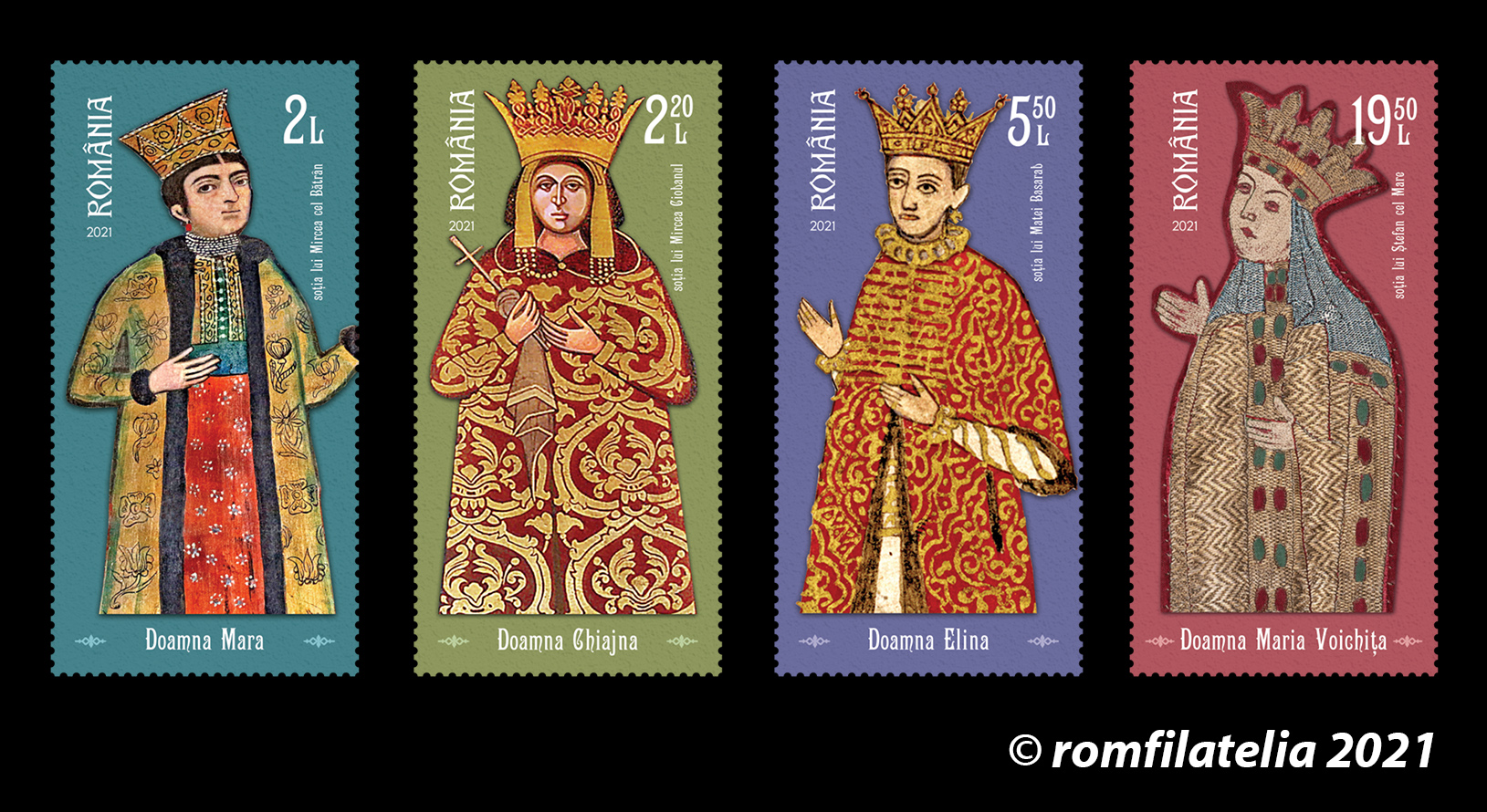
Romfilatelia recalls the figures of four of these ladies through the issue of postage stamps Ladies of the Romanian Voivodes, which will be put into circulation on Friday, May 21, 2021.
The stamp with a face value of 2 lei shows the figure of Mrs. Mara, the wife of Mircea the Old. Her face was preserved in the votive painting from the Brădet Hermitage, in Argeș County.
This lady of Wallachia is a mysterious figure. Neither the year of his birth nor the year of his death is known precisely (perhaps 1420, perhaps 1427?), Not even his family – it is believed that he came from a family of Hungarian nobles. It is traditionally called Mara, but its name has been reconstructed from an incomplete inscription, and some historians claim that it could have been called Ana or Klara as well. According to a current hypothesis, her name was Maria Tolmay, she owned a property near Lake Balaton, in the current territory of Hungary, and she was the mother of Mihail, the only legitimate son of Mircea the Elder, who associated him. this son to reign, later he ruled alone, after the death of Mircea, from 1418 to 1420.
On the stamp with a face value of 2.20 lei is represented Mrs. Chiajna, wife of Mircea Ciobanul, three times ruler of Wallachia (1545–1552, 1553–1554, 1558–1559). Her image has been preserved in the votive painting of the Princely Church of the Old Court (also called St. Anthony – Old Court), the oldest church in Bucharest.
In the troubled history of the Romanian Middle Ages, the second half of the 16th century was one of the most turbulent eras. The frequent changes of the rulers, the burdensome bureaus, the plots, the betrayals, the executions, the impoverishment of the population, all made this period “one of the dark ages of the history of the Romanian country”, as the historian Constantin C. Giurescu, author of the monumental History of the Romanians. Mrs. Chiajna, living in these dark times, appears herself as a dark figure. How deserved this reputation is, it’s hard to say now, after almost five centuries. Historians and writers have built a reputation as a tough, domineering woman, eager for magnification. The historian Constantin Giurescu makes a shocking characterization of her: a woman “energetic, of great will, fierce towards enemies, cultured, but unscrupulous and completely devoid of morality and modesty.” And Nicolae Iorga states, in the History of Romanians in faces and icons, that her hectic life, full of power struggles, intrigues and plots, was led by an “unquenchable passion to rule”.
At the death of Mircea Ciobanul, his son Petru cel Tânăr was only 12 years old. The true ruler of Wallachia became Chiajna, who succeeded in keeping her son on the throne for almost nine years (1559-1598). For this, he resorted to military confrontations with the enemies of the reign, to the purchase of political support from Constantinople with fabulous sums, collected by increasing bureaus, and to alliances with influential people, with whom he married his daughters. One of them was sent by his mother to the harem of Murad, the future sultan.
In 1568, Peter the Younger fell into disfavor with the Gate and was exiled with his mother. He died the following year; Chiajna, however, survived her for almost 20 years, dying in 1588, after, driven by her domineering nature, she had supported several other pretenders to the thrones of Wallachia and Moldavia, also through intrigues, plots and battles.
On the stamp with a face value of 5.50 lei is represented Mrs. Elina, wife of Matei Basarab, a gentleman who ruled Wallachia for over two decades (1632-1654).
Mrs. Elina is an unusual character: the less she is known, the more important her contribution to the evolution of the country was. Constantin C. Giurescu states that she was “one of the most important women of our nation.” Impressive characterization, which is based on the personality of Mrs. Elina and her contribution to Romanian culture. Elina Năsturel Her
escu came from a family of cultured people; her brother was the scholar Udriște Năsturel, poet, translator, a supporter of the printing and introduction of the Romanian language in the church (the language of worship was, at that time, Slavonic). Elina also received a chosen upbringing: she read a lot, she was interested in history and art, she knew Latin, Greek and Slavonic.
Unlike the dark times of the 16th century, the reign of Matei Basarab was, for Wallachia, one of relative stability and economic and cultural development. Mrs. Elina, who was his wife for 40 years, certainly had a contribution both to the beautiful reputation of the ruler and to the progress of the country. He supported the development of the printing press, founded churches, managed the royal residence and gardens, but, if necessary, he knew how to cope with the difficult occupation of running the country: “Bold woman, she took care of the country, in 1633, when her husband , who had taken his seat with weapons, went to Constantinople to get his reinforcement “, writes Nicolae Iorga, in the History of Romanians in faces and icons.
Her image appears in a book published during the reign of Matei Basarab (a Liturgist written in Wallachia by the grammarian Radu, 1653–1654), a testimony to the development of culture, to which Mrs. Elina also contributed.
Mrs. Maria Voichița, the third (and last) wife of Ștefan cel Mare, appears on the stamp with a face value of 19.50 lei. The image is found on a richly embroidered veil (curtain covering the altar door); the piece is known as Dvera Răstignirii, dates from 1500 and is today in the Museum of Putna Monastery.
Maria Voichița was the daughter of Radu cel Frumos, four times lord of Wallachia (1462-1473, 1473-1474, 1474, 1474-1475), and of his wife, Mrs. Maria Despina. She married Stephen the Great probably in 1478, after the lord had been widowed for the second time, following the death of Mary Comnena (Maria de Mangop), in 1477. The marriage followed dramatic events: in 1473, Stephen the Great undertook a military expedition to Wallachia, to dethrone Radu the Beautiful and enthrone a pretender supported by him, Basarab Laiotă the Elder. Stephen the Great’s relations with Radu the Beautiful were always hostile; Radu, raised in Constantinople, was too close to the Turks to be a comfortable neighbor to the voivode of Moldova. Stephen the Great dethroned him several times, through military interventions. Maria Voichița and her mother, Maria Despina, were taken hostage and taken to the citadel of Suceava. Voichița grew up, therefore, at Ștefan’s court, and in the end he married her. She had with her two daughters and a son, the future voivode Bogdan III, who ruled in Moldova between 1504 and 1517.
On the two envelopes “the first day” of the show are represented Mrs. Milita Despina, wife of Neagoe Basarab, lord of Wallachia (1512-1521), and Mrs. Stanca, wife of voivode Mihai Viteazul (1593-1600).
Romfilatelia thanks the Library of the Romanian Academy, His Eminence Calinic Argeșanul, Archbishop of Argeș and Muscel, Putna Monastery, St. Anton Church – Old Court in Bucharest and Dr. Sorin Iftimi, from the Museum of History of Moldova within the National Museum Complex “Moldova” , for the support provided to this postage stamp issue.