

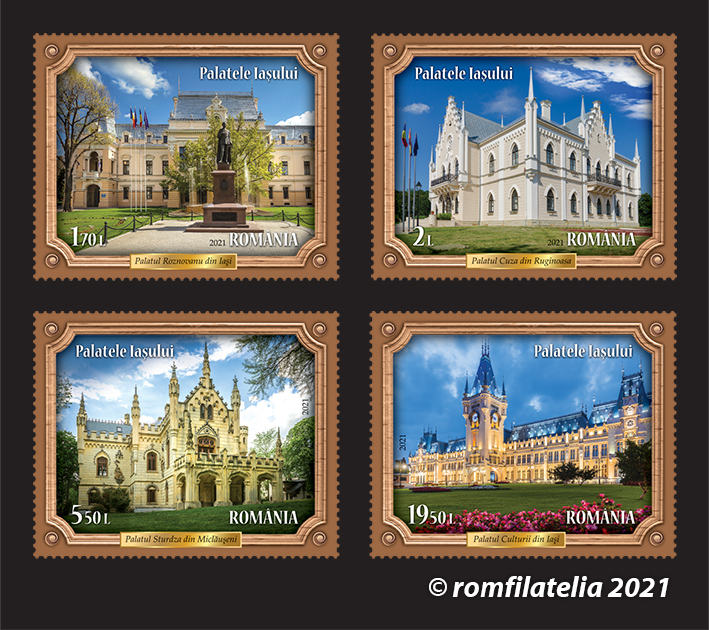
 Romfilatelia introduces into circulation, on Friday, June 4 a.c., a new issue of postage stamps dedicated to the valuable architectural heritage of the city and county of Iași: Iași Palaces.
The 4 stamps of the show illustrate four exceptional architectural monuments: Roznovanu Palace in Iași, Cuza Palace in Ruginoasa, Sturdza Palace in Miclăușeni and the Palace of Culture in Iași.
The stamp with a face value of 1.70 lei represents the Rosetti-Roznovanu Palace in Iași, the headquarters of Iași City Hall. The building dates from the end of the 18th century, but has undergone many transformations, the current appearance acquiring it at the end of the 19th century.
In the 18th century, on this place was a house of Matei Cantacuzino. It was bought by Nicolae Rosetti-Roznovanu, and after a few decades the first transformation took place: in 1832, the great treasurer Iordache Roset-Roznovanu rebuilt the building in a sumptuous style, marked by neoclassicism. In 1891, the Palace was bought from Nicolae Rosetti-Roznovanu, to serve as the seat of the city hall of Iasi, but in 1893, it was taken over by the state to be the residence of Crown Prince Ferdinand. Through the works carried out in the years 1895-1897, the construction was transformed again. In its current form, the palace belongs, as a whole, to the neoclassical style, with eclectic-baroque ornamental elements.
The building played a special role during the First World War, during 1916–1918, when it hosted the headquarters of some institutions of refugee political leadership in Bucharest. Since 1953, it has been used by the Iaşi Regional People’s Council. In 1970, the City Hall of Iaşi returned to its old headquarters, where it still operates today.
On the stamp with the nominal value of 2 lei is illustrated the Palace „Al. I. Cuza ”from Ruginoasa, built at the beginning of the 19th century.
The Ruginoasa estate had belonged to the Sturdza family, who, at the end of the 17th century, had bought it from Duca Vodă. In 1804, the great treasurer Sandulache Sturdza hired a Viennese architect
to rebuild the old mansion. The works were completed in 1814. Around the house, rebuilt in neoclassical style – and which now deserves its name as a palace -, a park was arranged.
The success of this extensive arrangement project is reflected in the impressions communicated by the writer Costache Negruzzi in the volume Negru pe alb. Letters to a Friend (1837). “Near Târgul-Frumos are the enchanting domains of Ruginoasa. The traveler receiving hospitality here, forgets the troubles of an annoying road. He seems to find himself transported as if by a charm to a castle described by Walter Scott […]. ”
Logopath Costache Sturdza, Sandulache’s son, however, wanted a different residence. The building was rebuilt in neo-Gothic style, as it is today. In 1857, Costache’s son, the governor Alexandru Sturdza, mortgaged the estate and the palace, but could not pay the loan installments, so the National Bank of Moldova put the estate up for auction.
It was bought in 1862 by Prince Alexandru Ioan Cuza, who wanted to turn it into a summer residence. The ruler spent little time at Ruginoasa; Instead, his wife, Mrs. Elena Cuza, lived here, who took care of the interior design (with furniture, wallpapers and precious decorative objects, many brought from France) and the restoration of the park. The palace was officially inaugurated by Prince Cuza on the occasion of the Easter holidays in April 1864.
During the First World War, the Ruginoasa Palace served as a military hospital, and in 1936 it became the property of Regia C.F.R., which set up a T.B.C.
Already degraded by its use as a hospital, the building was severely damaged during World War II. It was partially rebuilt in 1967-1978, and in 1982 became the Memorial Museum
„Al. I. Cuza ”, his patrimony also including pieces that had belonged to the Cuza family. Today, the building and the surrounding park are a museum attraction subordinated to the National Museum Complex “Moldova” Iasi.
The stamp with a face value of 5.50 lei represents the Sturdza Palace in Miclăușeni, built between 1880 and 1904 by George A. Sturdza and his wife Maria, on the site of an old mansion from 1755. Currently, it is owned by the Metropolitan Moldova and Bukovina.
However, the story of the castle begins around 1410, when the lord Miclăuș received from the ruler Alexandru cel Bun (1400-1432) an estate, later known as Miclăușeni. In 1591, the descendants of the lord Miclăuș sold the estate of the treasurer Simion Stroici, who built a mansion here, at the beginning of the 17th century. His heirs left the estate to relatives, Ioan and Sandu Sturdza. In 1752, the lord Ioan Sturdza rebuilt the mansion, transforming it into a spacious building with twenty rooms. His nephew Alecu arranged an English park around the mansion and enriched the library with rare books and manuscripts.
e, and Alecu’s son, George Sturdza, built in 1880–1904, on the site of the former mansion, a palace in late neo-Gothic style, remarkable both for the imposing elegance of the exterior and for the richness of the interior decoration and collections: marble stairs , parquet with inlays, paintings and sculptures, medieval weapons and costumes, silverware, medals and coins, as well as tens of thousands of books, many of them valuable by rarity or antiquity.
George Sturdza’s daughter, Ecaterina, was in charge of the castle for a long time. She left the palace in 1944 due to the proximity of the front, saving only some of the books. The castle and the remaining collections were devastated by the soldiers stationed here.
Towards the end of her life, Ecaterina Cantacuzino became a monk and donated the domain to the Roman Episcopate, which founded a monastery here. In 1953, the field was nationalized and had, over time, various destinations, including an explosives depot, a special school and a placement center for children.
After decades of neglect and misuse, the building was returned in 2001 to the Metropolitan Church of Moldova and Bukovina, which made it possible to carry out emergency repairs and, since 2004, a major restoration. Today, Sturdza Palace and its outbuildings can be visited and house an event center, accommodation and restaurant; the palace thus became again the elegant and welcoming building that was in the days of its former glory.
The stamp with a face value of 19.50 lei shows the Palace of Culture in Iasi, initially the Administrative and Justice Palace, today the headquarters of the National Museum Complex “Moldova”.
The Palace of Culture is a building-symbol of the city, built between 1906–1925, according to the plans of the architect I.D. Berindei. The building strongly marked the architecture of the old capital of Moldova, imposing itself, since its appearance in the city landscape, through its monumental dimensions.
In its appearance there is a successful combination of architectural styles: neo-Gothic, romantic and neo-baroque. The entrance to the palace is made through an imposing tower, 55 m high, having as a distinctive element a clock with three dials.
The official inauguration took place on October 11, 1925, in the presence of King Ferdinand and Queen Maria.
In 1955, the old Palace of Justice became the Palace of Culture, hosting cultural institutions representative of the country, reunited today under the name of the National Museum Complex “Moldova” Iasi.
The building has 298 rooms, with an area of approximately 36,000 m2. Two of the most famous rooms are the Hall of the Dukes (which owes its name to a gallery of portraits of the lords of Moldova) and the Hall “Henri Coanda” (decorated with beautiful stucco). Details from the two rooms are illustrated on the two “first day” envelopes of the show.
Romfilatelia thanks the City Hall of Iași, Dr. Sorin Iftimi, from the Museum of History of Moldova within the National Museum Complex “Moldova” Iasi, and the Metropolitan Church of Moldova and Bucovina for the documentary support provided to this postage stamp issue.