

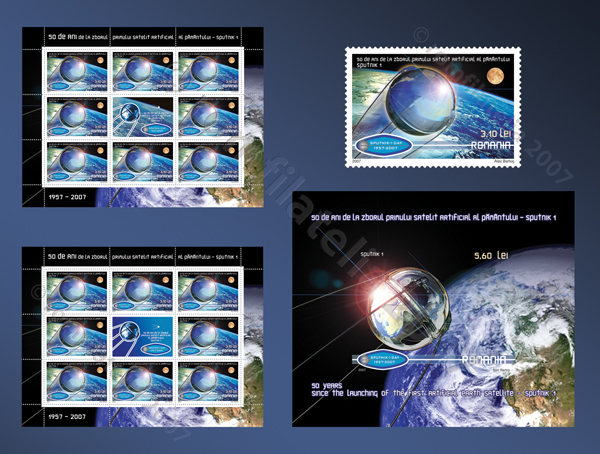
Five decades ago, mankind would, for the first time in history, witness the launch of an artificial satellite – designed and handcrafted by men – into space. Occasioned by the anniversary, Romfilatelia, the specialized company in editing and trading Romanian postage stamps introduces into circulation the philatelic issue 50 years since the launching of the first artificial Earth satellite – Sputnik 1.Five decades ago, mankind would, for the first time in history, witness the launch of an artificial satellite – designed and handcrafted by men – into space. Occasioned by the anniversary, Romfilatelia, the specialized company in editing and trading Romanian postage stamps introduces into circulation the philatelic issue 50 years since the launching of the first artificial Earth satellite – Sputnik 1. On October 4, 1957, the Soviet Union inaugurated the competition for Space conquest by launching Sputnik, the first artificial Earth satellite. The artificial satellite, called Sputnik I – translated as “travel companion” was launched from missile range at Kazakhstan. Sputnik I had a diameter
of 58 cm and a weight of around 84 kg. It made elliptical orbits around the Earth at an altitude of 250 km, every one hour and 36 minutes. Officially, the launch of Sputnik I was occasioned by manifestations related the International Geophysical Year. Visible through binoculars before sunrise and sunset, Sputnik I would transmit radio wave information back to the Earth, strong enough to allow reliable reception to radio amateur. In January 1958, Sputnik I deviated from initial planned trajectory that allowed it to stay in Earth orbit and entered the atmosphere disintegrating following self ignition.
The launch of Sputnik I marked the moment when the great nations of the world started the pursuit for the conquest of the extraterrestrial space, of the Moon, research on Mars as well as other planets in our solar system or even the ones further away.
Issue date: 2007-10-04