

 Near the most important event of Christianity, Romfilatelia introduces into circulation on Friday, April 2 a.c., the issue of postage stamps Holy Easter 2021, which commemorates crucial moments in the life of Jesus Christ – the Entry into Jerusalem, the Last Supper and the Resurrection.
The Easter holidays represent the foundation on which the whole edifice of the Christian religion rests, namely the Resurrection of Christ. Through Christ’s victory over death, Christians celebrate the Lord’s Resurrection at Easter, but also the consequence of the Resurrection, that is, the promise of our transition from death to life.
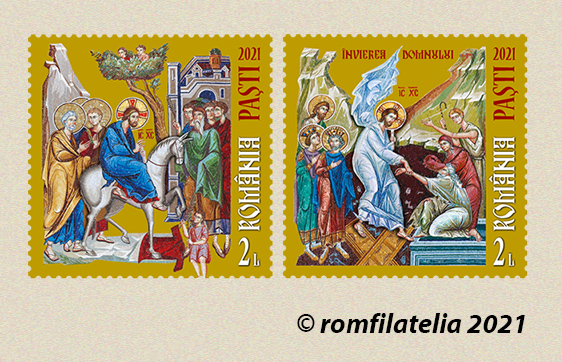
The two stamps of the postage stamp issue, with the same face value of 2 lei, illustrate the icons The entry of the Lord Jesus Christ into Jerusalem and the Resurrection.
The icon of the Last Supper is rendered on the stamp of the lace package of the show, with a face value of 31.50 lei.
The icons illustrated on the elements of the show can be found on the iconostasis of the Cathedral of the Salvation of the Nation.
The Lord’s entry into Jerusalem
The entry of the Lord Jesus Christ into Jerusalem is related in all four Holy Gospels of the New Testament (Matthew 21: 7-11; Mark 11: 1-10; Luke 19: 29-38; John 12: 12-15).
The Orthodox Church celebrates the event of the Lord’s Entry into Jerusalem one Sunday before the Feast of the Resurrection of the Lord Jesus Christ, that is, on Palm Sunday.
According to the Byzantine ermine, also described by the theologian Constantin Cavarnos, in his volume entitled Guide to Byzantine Iconography, the representation of the Lord’s Entry into Jerusalem depicts the Savior Christ entering the city of Jerusalem on a donkey’s colt. The city of Jerusalem is illustrated on the right of the stage, in the form of a fortress with open doors. A group of men, women, and children came out through the city gates, cutting branches and laying them in the way of the Lord Jesus Christ, shouting, “Hosanna to the Son of David!” These are the people who lived in Jerusalem and went out to meet the Lord Jesus Christ, about whose miracle they had heard and were astonished at the resurrection of Lazarus. Christ humbly blesses with his right hand and holds a phylactery in his left hand. The Byzantine representation of this icon depicts Christ the Lord seated with both feet on the same side of the donkey, facing the icon, unlike Western religious paintings in which Christ is usually depicted riding with his feet to one side. and the other of the donkey.
The entry of Christ into Jerusalem is a moment that illustrates the humility of the Savior, Who is acclaimed by the multitude of people, who, in a short time, would cry out that He would be crucified.
Last Supper
In the Holy Scriptures, the Last Supper is given in all four Holy Gospels (Matthew 26: 17-29; Mark 14: 12-25; Luke 22: 7-23, John 13: 1-28).
In the Orthodox Church, the Last Supper is celebrated during the Week of the Holy Passion of our Lord Jesus Christ, on Holy and Great Thursday.
At the Last Supper, the Lord Jesus Christ instituted the Sacrament of the Holy Eucharist. This Holy Sacrament, which is also called Holy Communion or Communion, is the center of the life of the Church. Through the Last Supper, Christ shows that the gifts of creation, represented by bread and wine, are gifts of His love for people, and when He sanctifies these gifts, transfiguring them through His very presence, He gives us eternal life: “Whoever eats My flesh and my blood is eternal life, and I will raise it up at the last day. For my flesh is true food, and my blood is true drink ”(John 6: 54-55).
The icon of the Last Supper is not absent from the iconographic program of the Orthodox churches, being painted in the nave, on the iconostasis or even in the altar.
This icon depicts the Lord Jesus Christ having dinner with His disciples before His Holy Passion. On the table are plates, bread, jugs and wine. Byzantine iconography depicts the table of the Last Supper as semicircular. Christ is placed in the middle of the semicircle of the table, thus being the center of the icon. He is also represented a little greater than His disciples. Christ blesses with his right hand; the disciples are seated on either side of Christ; John is seated on the left side, bent on the chest of Jesus (according to John 13, 23-25), and Peter is on the right side of Jesus, since he was the oldest of the disciples. Also on the right is depicted Judas, who extends his hand to the blid and looks at Jesus, thus showing his intentions as a traitor. The disciples are represented without halos, and the expression on their faces shows turmoil and sadness because Christ tells them that one will sell Him and He will be condemned to death. At the same time, the faces of the disciples are all oriented frontally, towards the viewer of the icon.
The resurrection of the Lord
The resurrection of Jesus Christ from the dead is point central to His earthly activity and the history of human salvation. The Holy Evangelists recount in detail this shocking and mysterious event, full of divine glory, through which the Savior Jesus Christ restores man and all creation (Matthew 28; Mark 16; Luke 24; John 20).
The usual icon, especially in Byzantine painting, of the Lord’s Resurrection is known as “Anastasis” (the Greek term for “Resurrection”), which represents Jesus Christ as Conqueror over hell and death. This icon is also called the icon of the Lord’s Descent into Hell.
The Lord Jesus Christ is represented as the Master of life and death, the Conqueror of hell, the Redeemer of those here. Christ the Savior looks tenderly on Adam’s face, begging for forgiveness. To Adam’s right is Eve, who is also on her knees with her hands raised in prayer to Christ the Savior. The clothes in which Eve is represented are reminiscent of the clothing of the Mother of God, thus suggesting that Jesus Christ, the Son of the Incarnate Son, the New Adam, was born as a man in the world through the new Eve, the Virgin Mary. To the left of the Lord Jesus Christ are painted King Solomon and King David, dressed in royal robes, with crowns on their heads, ancestors and prophets of the Messiah. They acknowledge Christ the Lord — the Messiah, showing to all the One of whom they had prophesied and whose coming they had announced. Behind Solomon we can see St. John the Baptist, the Forerunner who prepared the way of the Lord.
His Beatitude Father Daniel, Patriarch of Romania, teaches that the Resurrection of Christ is the beginning of the resurrection of all people, it is the Good News in its fullness and uniqueness, it is a guarantee of our resurrection. The Savior Christ Himself said, “I am the resurrection and the life; he who believes in Me, though he die, yet shall he live. And whosoever liveth and believeth in me shall never die ”(John 11: 25-26).
Romfilatelia thanks Blessed Father Daniel, Patriarch of the Romanian Orthodox Church, for his support in making this postage stamp issue.
The philatelic album is made in a limited edition of 267 copies and is equipped with a special philatelic block with three undamaged stamps (containing the two stamps of the series and the stamp of the package), as well as a philatelic cardboard on which are displayed the two lacy stamps of the series. , next to the “first day” stamp applied in clear, with gold foil. Both products are numbered from 001 to 267.
The icons The Lord’s Entry into Jerusalem, the Last Supper, and the Resurrection of the Lord, illustrated in this philatelic album, are found on the iconostasis of the Cathedral of the Salvation of the Nation.