

 Romfilatelia introduces into circulation, on Friday, March 12, 2021, a new postage stamp issue dedicated to the rich vegetal diversity of Romania: Flora from national reserves.
On the Romanian territory, approximately 3,700 plant species have been identified so far, representing about 30% of the species in Europe. These include about 1,400 rare or endangered species. They survive in protected areas throughout the country, from small-scale floristic reserves to large national parks and biosphere reserves.
These protected areas include a wide variety of habitats, from steppe meadows to mountain meadows, from bushes to swamps, from forests to sandy beaches.
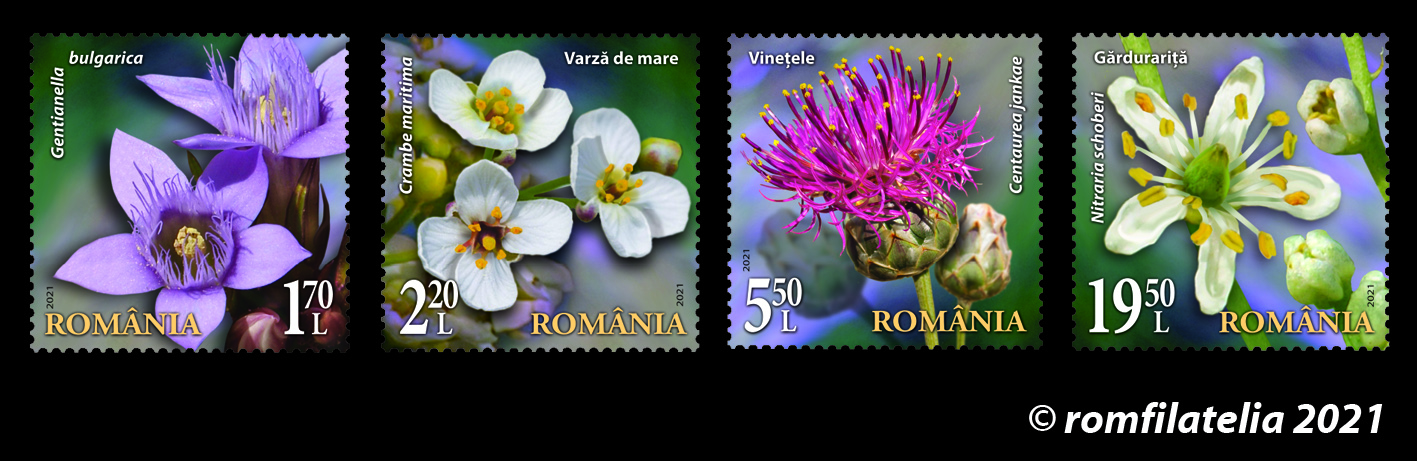
Gentianella bulgarica, represented on the stamp with a face value of 1.70 lei, is a species characteristic of the Carpathian Mountains and the Balkan Mountains. It is a short plant, 15-20 cm tall, with a often branched stem and numerous purple flowers. It blooms between July and September. It grows in mountain meadows. One of the protected areas where it can be found is the Bucegi Natural Park.
Sea cabbage (Crambe maritima), illustrated on the stamp with a face value of 2.20 lei, is a plant specific to European flora. It grows to a height of 75 cm. It is a halophilic plant (it can tolerate a high salt content in the soil). It grows on coastal sands, being spread on the shores of the Atlantic Ocean, the Baltic Sea and the Black Sea. It is rare in Romania, where it can be found on the coast and in the Danube Delta Biosphere Reserve.
Eggplants (Centaurea jankae), so named because of their purple flowers, are represented on the stamp with a face value of 5.50 lei. Centaurea jankae is a plant related to the usual bluish, but it is much rarer. It grows in Romania and Bulgaria, in our country being found in Dobrogea. It was first discovered in Babadag in 1884. One of the places where it can be found is the North Dobrogean Plateau, a site of Community importance, within the Natura 2000 Network (a European network of protected natural areas of Community interest, the main instrument of nature conservation of the European Union).
The woodpecker (Nitraria schoberi), which appears on the stamp with a face value of 19.50 lei, is a woody plant, which grows in the form of a bush 1-2 m high. It is a halophilic species found in the Muddy Volcanoes Nature Reserve, in Buzau.
The so-called “mud volcanoes” are one of the most interesting geological phenomena in our country. There are cones with variable heights and diameters (up to a few meters), which, under the pressure of natural gas underground, throw mud, consisting of mineral material and water.
The soil in the reserve, made up of mud thrown by “volcanoes”, is salty; therefore, few plants can grow here. The Muddy Volcanoes Reserve is the only place in Europe where this species can be found.
Romfilatelia thanks the Botanical Garden “Dimitrie Brandza” of the University of Bucharest for the documentary support and Mrs. Prof. Dr. Paulina Anastasiu, director of this institution, for scientific advice and photographic support for the production of this postage stamp issue.
The philatelic folder is made in a limited edition of 231 copies and is equipped with the special block of four lacy stamps of the issue presented as “first day” stamps with the stamp applied in clear with gold foil. The special philatelic block is numbered from 001 to 231.