

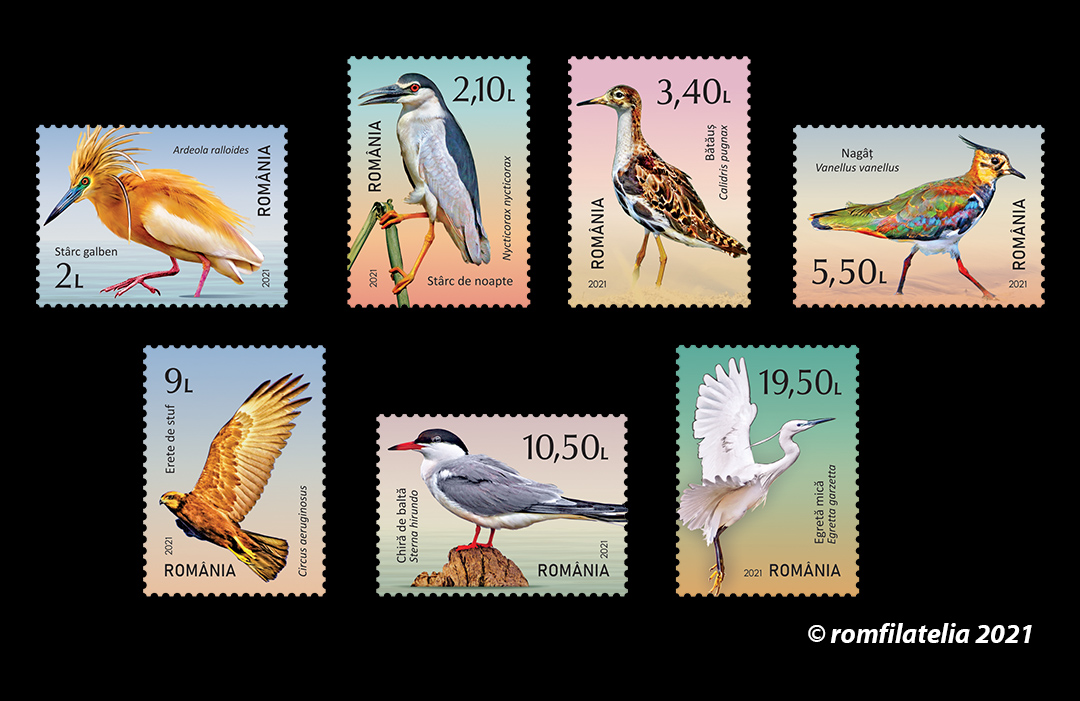
 Romfilatelia introduces into circulation on Wednesday, February 3, 2021, the issue of postage stamps Delta Moldovei, consisting of 7 postage stamps, to celebrate World Wetlands Day – February 2.
One of the most beautiful and rich natural areas in our country, the so-called Delta of Moldova includes the Jijie and Miletini Ponds and was recently declared the first Ramsar site in the Region of Moldova (Ramsar Convention is an intergovernmental treaty on wetlands of international importance, especially as waterfowl habitat). It consists of a variety of habitats located in the lower part of the Jijia River, before it empties into the Prut River. Among the wet habitats here, we mention rivers, temporary ponds, reeds, grassy swamps. They are bordered by pastures, bushes and even predominantly traditionally cultivated arable land.
This area of 19,432.5 ha is home to 225 species of birds, of which 140 species nest here, and during migration can provide a resting place for over 40,000 individuals.
The yellow heron (Ardeola ralloides) is illustrated on the stamp with a face value of 2 lei.
It is a small species, only 40-50 cm long and 250-400 g in weight. The female resembles the male, with light yellow plumage on the chest and flanks and darker on the back. The base of the beak turns bluish during the nuptials.
The yellow heron nests and feeds in natural, extensive aquatic habitats, with rich vegetation, in low areas, plains or hills. It feeds on molluscs (snails, shells) and other aquatic invertebrates, with amphibians or small fish.
The main threat is the burning of reeds, even in winter, because the colonies are located in areas with abundant vegetation. Also, the continuous degradation and diminution of wetlands is an accentuated danger.
The night heron (Nycticorax nycticorax) is represented on the stamp with a face value of 2.10 lei.
It is a medium-sized species, with a body length of 55-65 cm and a weight of 300-1000 g. The sexes are similar, with a plumage whose color varies from white-gray to black. On the head it has two elongated white feathers, more obvious during the reproduction period.
It nests in colonies located in wetlands, either in high vegetation or in shrubs or trees. It consumes a wide variety of aquatic species, from small fish, amphibians, reptiles, to insects or mollusks.
The main threat is the degradation of wetlands, especially by shrinking their areas.
The bully (Calidris pugnax) is represented on the stamp with a face value of 3.40 lei.
It is a species of wader (shorebird) of medium size, having a length of 23-35 cm and a weight of 90-250 g. Males differ from females, being larger, and their plumage during the nesting period is spectacular, with moths on the head and with elongated feathers of various colors on the goiter and neck. The diversity of colors is so great that no male is identical with another. The female is smaller, has a duller color, a light brown, with large black spots.
The bully nests in the northern part of Europe, being present in our country during the passage period, practically on the way to / from the winter districts of Africa. It mainly eats insects, but also mollusks, spiders, frogs or small fish.
It is a species sensitive to climate change, because it needs a synchronization of the water level with that of the vegetation in order to nest. The destruction of wet habitats in nesting areas, but especially in those located on the migration route, by reducing the area or by pollution and disturbance, causes a sharp decrease in the population of bullies.
The wagtail (Vanellus vanellus) is illustrated on the stamp with a face value of 5.50 lei.
It is a wader (shore bird) of medium size, with a length of 65-75 cm and a weight of 150-300 g. The sexes are similar, presenting a black and white plumage, but with greenish, purple and brown iridescences. It has a long black ridge on its head.
It nests on the ground, predominantly near wetlands, although sometimes even on more remote agricultural land. It feeds on insects, worms and other invertebrates.
Nagata is experiencing a massive decline in Europe due to the degradation of aquatic habitats, intensified agriculture and predator access to nesting areas. The biggest problems are the loss of traditional agricultural mosaics and the widespread use of insecticides.
The reed heron (Circus aeruginosus) is depicted on the stamp with a face value of 9 lei.
It is a species of bird of prey of medium size, having a length of 45-55 cm and a weight of 500-700 g. The female differs from the male, being dark, having only a white-yellow head and goiter. The male has silver-gray wings with black tips and a rusty abdomen.
It nests in areas with high grassy vegetation and a large nest
The village on the ground is made up of branches, reeds and grass. It is a predatory species; it feeds on birds, small rodents, frogs, insects and, occasionally, shells.
Degradation of aquatic habitats, illegal hunting and poisoning are the main dangers for this species. Also, the intensive use of pesticides in agriculture can cause the sterility of individuals and even their death.
Pond chira (Sterna hirundo) is represented on the stamp with a face value of 10.50 lei.
It is a medium-sized species, 34-37 cm long and weighing 97-146 g. The female resembles the male, with a white chest and belly, a gray back and a black back. The only spot of color is given by the red beak with the black tip, but it disappears in winter, when the beak turns completely black. The entire plumage opens in winter, the black on the head narrowing to its back.
It nests in aquatic areas, on low, isolated shores, poor in vegetation, preferring areas where predators do not have access (islands, rocks). It predominantly eats small fish, but can also catch crustaceans, insects or other small animals from the surface of the water.
The main threat is the degradation of wetlands, both by reducing areas and by pollution. Another threat is climate change, which causes large fluctuations in water levels, causing flooding of nests.
The little egret (Egretta garzetta) appears on the stamp with a face value of 19.50 lei.
It is a small species of heron, with a graceful appearance. The length of the body is only 55-65 cm, and the weight is 350-550 g. The sexes are similar, the plumage is completely white, only the toes are yellow, contrasting with the rest of the legs and the beak is black.
It nests in wetlands, along with other herons (colonial species). The nest is located on the ground, in tall grassy vegetation or in shrubs and trees. It feeds on small fish, amphibians, mollusks (snails, shells) or other invertebrates.
Reducing the area of wetlands or degrading them, disturbing the colonies and cutting down clusters of trees on which it can nest are considerable threats to the species.
The stalk (Himantopus himantopus) is represented on the “first day” envelope of the show.
It is a bird characteristic of low water areas. It has a length of 33-36 cm and a weight of only 150-200 g. The sexes are similar to each other, have white and black plumage, and the legs and beak are reddish.
It nests in small colonies, located directly on the ground, near wetlands. It feeds on insects, mollusks (snails and shells), crustaceans, spiders, small fish or even seeds.
Degradation of wetlands by declining areas and pollution are the main dangers affecting the species. Anthropogenic disturbance and uncontrolled tourism are other serious threats.
Romfilatelia thanks the University „Al. I. Cuza ”from Iași – The marine biological resort“ Prof. Dr. Ioan Borcea ”from Agigea, Dr. Emanuel Ștefan Baltag, scientific researcher, and Dr. Lucian Fasolă-Mătăsaru for the documentary and photographic support granted to the realization of this stamp issue.
The philatelic folder is made in a limited edition of 203 copies and is equipped with the special block of 7 lacy stamps, of the issue, with the stamp applied clearly with gold foil. The philatelic block is numbered from 001 to 203.