

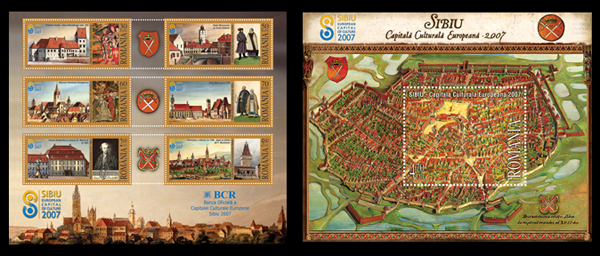
 Romfilatelia, the specialized company in editing and trading Romanian postage stamps, joining important cultural events which take place in 2007 in Sibiu, European Capital of Culture, achieved a philatelic issue dedicated to this major event, of national significance: SIBIU – EUROPEAN CAPITAL OF CULTURE 2007.Romfilatelia, the specialized company in editing and trading Romanian postage stamps, joining important cultural events which take place in 2007 in Sibiu, European Capital of Culture, achieved a philatelic
issue dedicated to this major event, of national significance: SIBIU – EUROPEAN CAPITAL OF CULTURE 2007. In May 2004, in the Assembly of the Culture Ministers from the EU
member states, held for the first time in “a 25 format” in Brussels, the Council of Ministers appointed the cities of Luxemburg and Sibiu as European Capitals of Culture in 2007.
The election of Romania to elaborate an international project of this importance – being the first Eastern European country to organize an European Capital of Culture, after the extension of the European Union, as well as the first with which an Eastern-Western partnership is set up, represents for us a chance to introduce the Romanian people with new and multiple bonds, tightly connected to its history and with the common cultural traditions with the other European nations. With its paved streets and houses built in a Saxon style, the city of Sibiu (Hermannstadt), first attested in a document in 1191, is a true
outdoor museum. At each step you meet history, with the tours of medieval fortress, with the monumentality of the churches or with the uniqueness and special value of the exponents in the biggest outdoor
museum in Europe, Astra Museum. But Sibiu also offers national or world premieres such as: the first Romanian hospital (1292), the first country pharmacy (1494), the first paper mill (1534), the first lightning rod in South-East Europe (1795), the first homeopathic lab in the world (1797), the first Romanian Museum – Brukenthal (1817), The Liars Bridge (or The Bridge of Lies) (1859) – the oldest metal bridge in the country, the second city (after
Timisoara) in Europe to introduce the electric tram (1904), the first Zoo in Romania, built in 1928. Sibiu, the city of the year 2007 represents Romania through its traditions, architecture, music, theatre, through Cioran, Blaga or Goga, or through the multiple exhibitions and cultural manifestations. Sibiu´s culture is transmitted through art and creation language, appearing as a true artistic mirror of Romania, in which the hospitability
of the people of Sibiu is reflected and known to the entire Europe. The stamps of the philatelic issue highlight époque images of monuments representative of the old Sibiu. On the stamp with the face value of RON 0.30 we find the image of the Old City Hall – Altemberger House, after the name of the Mayor in whose era the building started to be erected in the current form representing the most important Gothic civil architecture complex in Transilvania. The oldest part of the building is the tour-dwelling, Thomas Altemberger, mayor of the city between 1470 and 1491, starting the construction at the end of the 15th century. Together with the image of the Old City Hall on the stamp there is illustrated a detail, “Knights” from the altar of the fortified church (15th century) in Dupus, attested in a document in 1267. On the stamp with the face value of RON 0.50 we find two renowned
travel spots, the Liars´ Bridge and the Council Tour. The oldest metal bridge (of cast iron) in Romania, i.e. the Reclined Bridge as it is called, was built in 1859, and the name of the Liars´ Bridge is connected to the
lies told by people who set on the benches, at gossip, near the bridge. The Council Tour represents the symbol of Sibiu and is for the first time mentioned in 1370, together with the building where the “city council”
assembled, from which it got the name that it carries today. On the same stamp a drawing which represents two 18th century Transylvania Saxons can also be found. On the stamp with the face value of RON 0.60 the Parochial
Evangelic Church known under the name of the Evangelic Cathedral is depicted. The Gothic cathedral was built in the 14th century. The year of initiation of the construction of the 73 m tour is known, being 1371.
Although a series of cultural golden silver vases are not accessible to the public, the pieces exhibited are highlighted through richness, originality, diversity and special artistic value. In the church there is also one of the
most beautiful bronze baptismal fonts in the country, the work of the master Leonhardus from 1438. The organ was built in 1672. On the same stamp a detail of the church painting is also reproduced representing the
Crucifixion, a 15th century painting. On the stamp with the face value of RON 0.70 a panoramic image of the Grand Square at 1780 is shown. This square is located in the historical center of Sibiu and was attested for the first time as a cereal market in a 1411 document. Across time, this place was used for meetings but also for public executions. The market has 142 m length and 93 m width, being one of the biggest in Transylvania. The south side was declared architectural monument. On the same stamp we can also find the image of peasants from Marginimea Sibiului with their traditional costumes, reproducing an 18th century drawing. On the stamp with the face value of RON 2.10 the Brukenthal Palace and the Saint Nepomuk Statue around 1935 are depicted. Brukenthal Palace is one of the most important Baroque style monuments in Romania, built in stages, between 1778-1788, to serve the baron Samuel von Brukenthal as an official residence and to shelter its collections, which can be visited in 1790, three years before the opening of the Louvre Museum in Paris. The Baroque halls, the reception spaces and
musical soirees, preserve the original pieces of the Palace: the stoves in Rococo and Neoclassical style, the red silk and wallpapers painted in oriental style, the Murano glass chandeliers and 18th century Transylvanian furniture
pieces. Brukenthal Museum was officially opened in 1817, thus being the oldest Central European Museum. The statue of Saint Martyr Johannes Nepomuk, built in 1734, rests nowadays in the yard of the parochial
house of the Catholic Church from the Great Square. On the same stamp we find illustrated the portrait of the baron Samuel von Brukenthal (1721-1803), governor of Transilvania in the period 1777-1787.
On the stamp with the face value of RON 5.60 a Panoramic image of Sibiu from 1790 – after a painting, made by F. Neuhauser is depicted. Along with this, on the stamp the Cisnadie Gate Tour is also
illustrated, in a J. Böbel watercolor. On the philatelic souvenir sheet is illustrated a reproduction of the Sibiu Fortress from the middle of the 17th century.
Issue date: 2007-06-11