

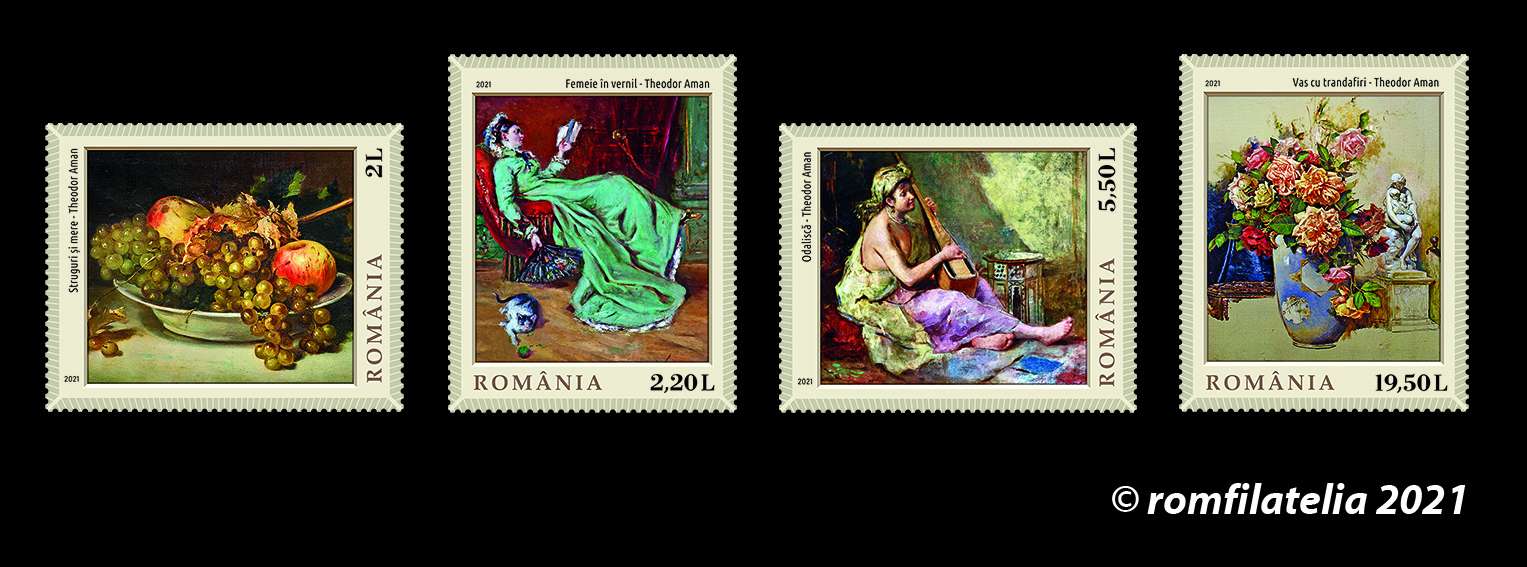
 Romfilatelia introduces into circulation, on Wednesday, March 24, 2021, a stamp issue dedicated to Romanian visual arts and the anniversary of one of the most famous Romanian artists: Theodor Aman, 190 years since his birth.
The “Theodor Aman” Museum, the first art museum in Bucharest, officially opened on June 16, 1908, right in the house where Theodor Aman lived and created for almost 22 years (March 20, 1831 – August 19, 1891). The building located on Rosetti Street (former Clemence) was designed and erected by Aman between 1868 and 1869, being to an overwhelming extent the fruit of the artist’s thinking and talent, who is the author of the architectural project, exterior and interior decoration ( stained glass, mural painting, carved medallions on doors, furniture, paneling and workshop stove, ceiling stucco). The eclectic building, assimilated mainly to the French neoclassical typology, is also the first house-workshop in the Romanian space, conceived from the very beginning to become a museum.
Theodor Aman, our first academic painter and founder, together with Gheorghe Tattarescu, of the School of Fine Arts in Bucharest, is the promoter of modernity in Romanian art, and his work reveals his extraordinary stylistic versatility, the artist managing to cover a very wide beach, from rigorous, strict and scenic academic works, up to sensitive and fascinating pre-impressionist expressions, in which the rigor of the construction is deliberately neglected in favor of suggestion and impression.
In 1891, on the artist’s death, the house and the entire collection were bequeathed to his wife, Ana Aman, who sold them in 1904 to the Ministry of Cults and Public Instruction in order to open the current museum.
The museum’s collection includes works by Theodor Aman, covering various genres, styles and techniques, as well as all stages of his creation, from childhood to the end of his life: 165 oil paintings on canvas or wooden panels, 33 watercolors, 298 engravings and 62 engraving plates, pencil and pen drawings, sculpture, which, in addition to 3 busts, includes pieces of furniture and 4 medallions carved on the doors, mural painting and stained glass. The existing patrimony also includes the artist’s work utensils, musical instruments and weapons, several pieces of oriental or national costume, ceramic vessels, beads, hookahs and other personal items, which complete the collection of over 1,000 pieces of the museum.
Grapes and apples (oil on canvas, 1875 – 1880?), Reproduced on the stamp with a face value of 2 lei, is a static nature from the early period, in which the artist is a tributary of a descriptive style, approaching an exacerbated naturalism, caravaggist and imposing itself through the precision of the execution, through the finesse and meticulousness of the visual perception, through the sensitivity with which it harmonizes the chromatic values and the dialogue between lights and shadows.
Woman in Vernil (oil on wood, 1879), represented on the stamp with a face value of 2.20 lei, is a genre scene painted right in the artist’s house and in which his wife, Ana Aman, is represented; is part of the category of works that can be assimilated to a vintage diary, which offers us the opportunity to reconstruct everyday life, atmosphere, clothing fashion, elegant interiors, refined details of decor or architecture.
Odalisque (oil on canvas, 1885 – 1890?), Depicted on the stamp with a face value of 5.50 lei, is a late work, of deep maturity, in pre-impressionist treatment, which can be considered a strong piece of resistance within the oriental scenes of Haman, in which one can discover an Orient viewed with affection, an Orient in which lyricism, calm, melancholy and sensuality dominate.
Vase with roses (oil on canvas, 1890 – 1891?), Reproduced on the stamp with a face value of 19.50 lei, is a painted work in the last year of life; it identifies with the apogee of Aman’s static natures and belongs to the non-finite category, a concept he experiences with spectacular results. In this case, we are faced with an optical illusion generated by the 3D effect induced by the image in which the suggestion prevails and demonstrates the artist’s ability to overcome his contemporaneity.
Two other works by the artist are illustrated on the two “first day” envelopes of the show.
One of these is the Aman Brothers – detail – (oil on canvas, 1885?), A work perceptible as a photograph with a role of memory, in which the artist represents himself with his brothers, already gone from the world of the living. The characters are placed in Aman’s famous workshop, at a time in their past, when they were physically together.
Rustic scene (etching, 1875) is performed in one of the techniques in which Aman excelled (etching), being received in the Society of Etchers in Paris. He was considered until the end of his life the best Romanian painter-engraver.
Romfilatelia thanks the Museum of the Municipality of Bucharest for the documentary and photographic support granted to the realization of this issue of postage stamps.
The philatelic folder is made in a limited edition of 251 copies and is equipped with the special philatelic block of four undamaged stamps of the issue, with the stamp applied clearly, in gold foil. The special philatelic block is numbered from 001 to 251.